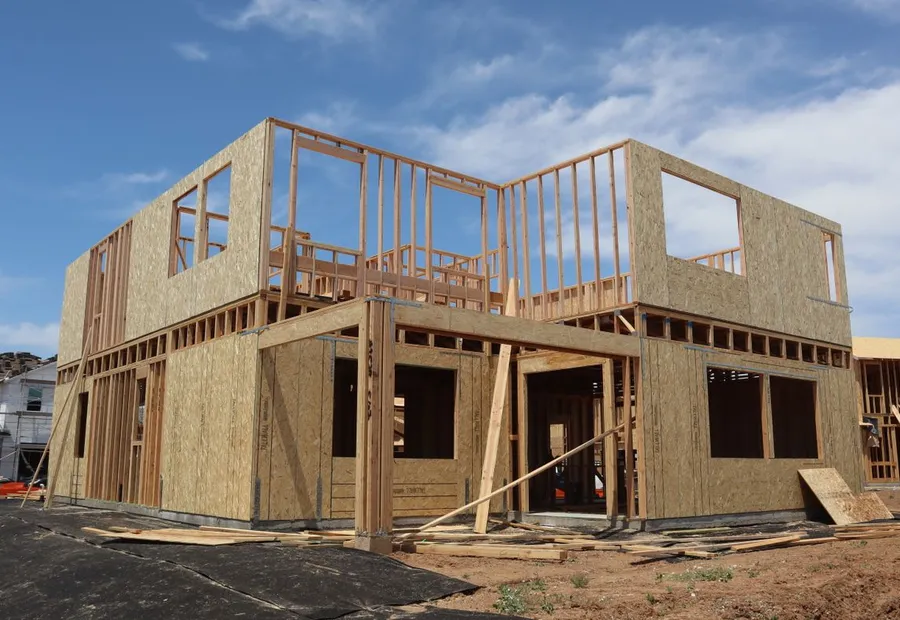
One word, three products
Offsite is a trade word, not a category with edges. The Census Bureau, which has counted new houses by construction method since 1992, does not use it at all. It records three named methods and a residual, and the definitions are worth reading closely because almost every argument about factory housing turns out to be an argument about which of them someone means.
A modular house is one where, in the Bureau's words, finished three-dimensional sections of the complete dwelling are built in a factory and transported to the site to be joined together on a permanent foundation. [1] A panelised house is a package of wall panels, roof trusses and other components shipped from a factory and assembled on site. A precut house is a package of lumber or timber cut to exact size, length and quantity, and shipped to be assembled on site. Site-built is the residual, and the Bureau is explicit that a site-built house may still contain factory components: roof and floor trusses, wall panels, door frames.
That last clause is the one that undoes most marketing. Nearly every house built in North America today contains factory-made components. Trusses have been engineered offsite for decades. The question is never whether a house is factory built. It is how much of it arrives finished, and where the inspection happens.
The line that actually has legal weight
The distinction that changes a buyer's life is not modular against panelised. It is manufactured against everything else, and it is federal.
A manufactured home is defined in statute as a structure, transportable in one or more sections, which in the traveling mode is eight body feet or more in width or forty body feet or more in length, or when erected on site is three hundred twenty or more square feet, built with or without a permanent chassis and designed to be used as a dwelling with or without a permanent foundation when connected to the required utilities. [3] A home meeting that definition is built to a federal construction and safety standard rather than to the building code of the place it lands.
A modular home is the opposite arrangement. It is built to the same building code as a site-built house in the jurisdiction where it will stand, and it is inspected against that code. The factory is where the inspection happens rather than the standard being different.
Everything downstream follows from which side of that line a house sits on: how it is financed, how it is appraised, whether a zoning district that excludes manufactured housing excludes it too, and what an insurer will write. A buyer who does not know which one they are being sold does not know what they are buying.
Note
Building codes are adopted and amended locally. What governs a modular house is whatever edition your jurisdiction has adopted, with whatever amendments it has made, and the authority having jurisdiction is the only office that can tell you which that is.
How small this category actually is
Factory housing has been ten years away from transforming homebuilding for about fifty years. The federal count says otherwise, and it says so consistently.
Of the 1,005,000 new single-family houses completed in the United States in 2025, 975,000 were site-built. Modular accounted for 14,000. Panelised and precut together, which the Bureau reports as a single residual category, accounted for 16,000. [2]
The trend is the part that gets left out of the pitch. Modular completions peaked at 46,000 units in 2002, when they were 3 percent of a 1,325,000-unit year. They have not been above 3 percent since 2007, and they have rounded to 1 percent every year since 2018. The share has not stalled. It has fallen, through two decades in which the case for building indoors got stronger rather than weaker. The Build Sheet treats that as the central fact about the industry rather than an awkward footnote to it.
| Method | Houses (thousands) | Share |
|---|---|---|
| Site-built | 975 | 97% |
| Modular | 14 | 1% |
| Panelised and precut | 16 | 2% |
| Total | 1,005 | 100% |
Where it does land, and why that is the interesting part
The national share hides the real pattern. Modular is not evenly thin across the market. It is almost absent from one half of it and materially present in the other.
Of the 721,000 houses built for sale in 2025, the ones a production builder puts up on land it owns and sells finished, modular units rounded to under 500, which the Bureau flags rather than prints. Of the 130,000 contractor-built houses, the ones an owner commissions on land they already hold, 8,000 were modular. That is 6 percent. In the Northeast, contractor-built modular reached 16 percent. [2]
So the method works, and it works specifically where somebody is building one house on their own lot and wants a fixed scope. It has failed to reach the volume builders, who are where the volume is. Any claim that factory housing is about to solve housing supply has to explain that gap first.
Questions
- Is a modular home the same as a manufactured home?
- No, and the difference is legal rather than descriptive. A manufactured home is built to a federal standard and meets the statutory definition in 42 U.S.C. 5402. A modular home is built to the building code adopted by the jurisdiction it will stand in, the same code a site-built house meets there.
- Does a modular house get inspected?
- Yes, and usually more times than a site-built one. The difference is that most of the inspection happens in the plant, against the code of the destination jurisdiction, before the walls close. The local authority still inspects the foundation, the set and every connection made on site.
- Is factory built cheaper?
- Not reliably, and the factory price is not the comparison that matters. It excludes land, site work, foundation, transport, the crane and the utility connections. A quote that covers a house and a quote that covers a set of modules are different documents.
Sources
- 1U.S. Census Bureau. Survey of Construction: Definitions. Accessed 2026-08-29
- 2U.S. Census Bureau. Type of Construction Method of New Single-Family Houses Completed, Characteristics of New Housing, 2025 data, released 1 July 2026. Accessed 2026-08-29
- 3Office of the Law Revision Counsel, U.S. House of Representatives. 42 U.S.C. 5402, Definitions, National Manufactured Housing Construction and Safety Standards. Accessed 2026-08-29